

The important & standard post format
Investigationes demonstraverunt lectores legere me lius quod ii legunt saepius. Claritas est etiam processus dynamicus, qui sequitur mutationem consuetudium lectorum.



The Yoast Analytics plugin lets you easily connect your website to Google Analytics and keep track of all your site traffic and key metrics in real-time.
Investigationes demonstraverunt lectores legere me lius quod ii legunt saepius. Claritas est etiam processus dynamicus, qui sequitur mutationem consuetudium lectorum.
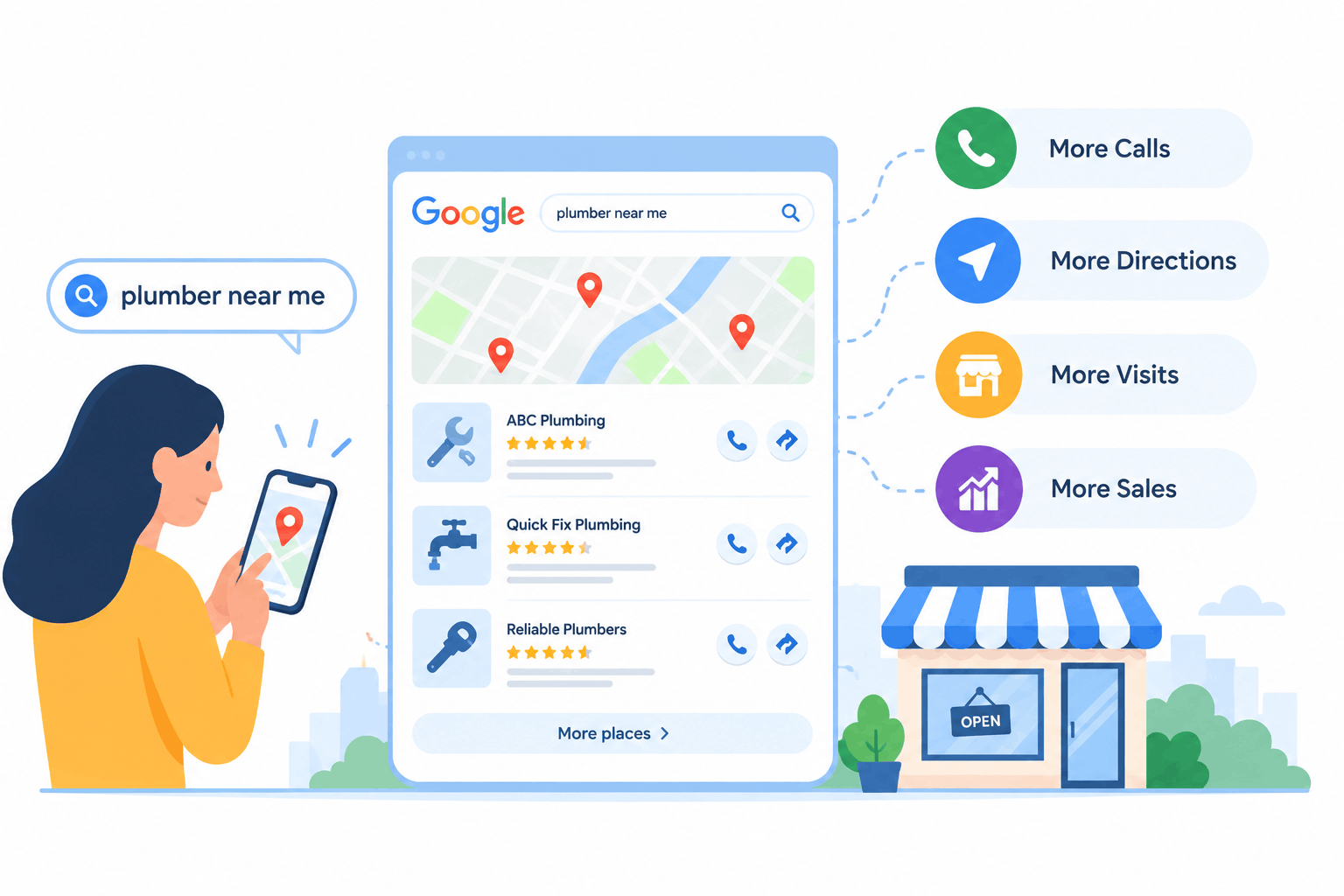
Think about the last time you searched for “dentist near me,” “best biryani in my area,” or “plumber open now.” You almost certainly picked one of the first three businesses on the map, called them or tapped for directions, and never scrolled further.
That moment is exactly what local SEO is built for.
Google now treats a huge share of searches as local in intent, and mobile users act fast: they search, compare ratings, call, and visit, often within the hour. If your business is invisible in those results, a competitor is getting the customer you deserved.
This guide explains what local SEO is, how Google decides who ranks, every major term you need to know, and the exact step-by-step process to rank higher on Google Maps and turn searches into calls, visits, and sales.
Local SEO (local search engine optimization) is the practice of optimizing your online presence so your business appears in search results when people nearby look for the products or services you offer. It covers Google Search, Google Maps, and other platforms such as Apple Maps, Bing Places, and Yelp.
While traditional SEO helps a website rank nationally or globally, local SEO helps a business rank in a specific geographic area: a city, a neighbourhood, or a service radius.
Local SEO is essential for:
| Factor | Traditional SEO | Local SEO |
| Goal | Rank for topics and keywords broadly | Rank for nearby, location-based searches |
| Main result type | Organic blue links | Local Pack, Google Maps, and organic results |
| Key asset | Website content and backlinks | Google Business Profile, reviews, citations, and website |
| Top signals | Content quality, authority, links | Proximity, relevance, prominence, reviews |
| Main conversion | Page visit or sign-up | Call, direction request, store visit, or booking |
Understanding the different places your business can show up helps you target the right ones.
1. The Local Pack (Map Pack). The block of three businesses shown with a map near the top of the results. It displays business name, rating, reviews, address, hours, and one-tap buttons to call or get directions. This is the most valuable real estate in local search.
2. Google Maps. When people search directly in the Maps app, the results are drawn from Google Business Profile data. This is where many “near me” searches end.
3. Local Finder. The expanded list that appears when a user clicks “More places” under the Local Pack.
4. Localized Organic Results. Regular website listings that Google tailors to the searcher’s location, such as “best interior designer in [city].”
5. Knowledge Panel. The business information box on the right side of desktop results or at the top on mobile when someone searches for your brand name.
6. AI Overviews and AI-assisted local answers. Google increasingly summarizes local options with generated answers. Businesses with complete profiles, strong reviews, and clear, trustworthy website content are more likely to be referenced.
Google has publicly explained that local results are mainly based on three things: relevance, distance, and prominence.
Relevance is how well your business matches what the searcher wants. Google judges this by looking at:
If someone searches “emergency AC repair,” a business categorized as “Air Conditioning Repair Service” with a dedicated emergency repair page will be seen as more relevant than a general electrician.
Distance is how close your business is to the person searching, or to the location mentioned in the query. Proximity is the one factor you cannot fully control, but you can influence how far your visibility reaches by strengthening relevance and prominence. Ranking at the center of a city is easier than ranking at its edges, which is why geo-grid rank tracking (heatmaps) is so useful.
Prominence is how well-known and trusted your business is, online and offline. Signals include:
In short, Google asks: Is this business a good match, is it close enough, and can we trust it? Local SEO is the process of answering “yes” to all three.
Here are the key terms you will meet in any local SEO strategy.
Now for the practical part. Follow this process in order for the strongest results.
Before changing anything, find out where you stand.
The audit becomes your roadmap and your benchmark.
Local keywords reveal exactly how nearby customers search. Build a list using:
Group keywords by intent (urgent, comparison, informational) and map each group to a page or profile section.
Your Google Business Profile is the single most influential asset in local SEO. Treat it as a live storefront.
Core information
Content and engagement
Verification and compliance
Citations tell Google your business is real, established, and located where you say it is.
Quality and accuracy beat sheer quantity. A few dozen consistent, relevant citations outperform hundreds of messy ones.
Reviews influence both rankings and conversions. Businesses with more recent, high-quality reviews tend to dominate the local pack and win more clicks.
Review text also provides keyword and context signals that help Google understand what you are known for.
Your website supports your GBP and ranks for local organic searches.
Schema is code that helps search engines understand your business details precisely. Implement LocalBusiness schema (or a more specific subtype, such as Dentist, Restaurant, or LegalService) with:
Validate your markup using Google’s Rich Results Test and Schema Markup Validator.
Most local searches happen on phones, so technical performance matters.
Local content shows genuine community expertise and attracts links and engagement.
Write for people first. Helpful, original, experience-based content is rewarded far more than keyword-stuffed pages.
Backlinks from relevant, local websites boost prominence.
A handful of authoritative local links can move rankings more than dozens of low-quality ones.
Social media does not directly rank you, but it builds awareness, branded searches, and engagement, all of which support prominence.
Search is evolving through voice assistants, conversational queries, and AI-generated answers.
Local SEO is ongoing, so measure what matters.
Key metrics:
Common tools: Google Business Profile Performance, Google Search Console, Google Analytics 4, and specialized local SEO platforms for rank tracking, citation management, and review monitoring.
Review results monthly, learn from what moves the needle, and refine your strategy.
Hide your address if customers do not visit you, define your service areas accurately, and create separate website pages for each major area you serve. Keep proof of real local work through photos, projects, and reviews from different neighbourhoods.
Create a separate GBP and a unique location page for each branch. Use consistent branding but unique content, local staff, photos, and reviews per location. Manage listings centrally with accurate store codes, hours, and attributes.
If you also serve customers locally through a showroom, pickup point, or events, treat those touchpoints as local entities with their own profiles and landing pages.
Some improvements, such as fixing a profile or correcting categories, can show impact within a few weeks. Most businesses see meaningful, stable movement in the local pack within three to six months, depending on competition, location, existing authority, and the consistency of effort. Highly competitive industries in dense cities may take longer, but the results compound over time and keep delivering without paying for every click.
Paid options such as Google Local Services Ads and local Google Ads campaigns can deliver quick visibility. Local SEO builds a lasting, cost-efficient asset that keeps working even when budgets pause. The strongest strategy often combines both: ads for immediate leads, and SEO for long-term growth and lower cost per customer.
What is the difference between local SEO and regular SEO? Regular SEO targets broad rankings without geographic limits. Local SEO focuses on appearing for searches tied to a specific place, mainly through Google Business Profile, reviews, citations, and location-based content.
How do I rank higher on Google Maps? Fully optimize your Google Business Profile, choose accurate categories, build consistent citations, earn regular reviews, add local keywords on your website, earn local backlinks, and keep your profile active with photos and posts.
Do reviews really affect local rankings? Yes. Quantity, quality, recency, and your responses influence both visibility and customer trust, and they strongly affect whether people choose you.
Do I need a website for local SEO? You can appear on Google Maps with only a profile, but a strong, mobile-friendly website with local content and schema significantly improves rankings, credibility, and conversions.
Is local SEO worth it for small businesses? Absolutely. It targets people who are already searching nearby and ready to buy, which makes it one of the highest-return marketing channels for small and local businesses.
How often should I update my Google Business Profile? Check it weekly. Post updates, add photos, answer questions, reply to reviews, and update hours or services whenever something changes.
Local SEO is not a trick or a one-time task. It is a system: a complete Google Business Profile, consistent business information, trusted reviews, helpful local content, a fast mobile website, and a steady stream of local signals that prove you are the best nearby choice.
Businesses that commit to this process do not just rank higher on Google Maps. They get more phone calls, more walk-ins, more bookings, and more loyal customers from the people who live and work around them.
Ranking in the local pack takes strategy, consistency, and expertise, and that is exactly what we deliver. From Google Business Profile optimization and citation building to review management, local content, and technical SEO, our team handles every step so you can focus on running your business.
Get found. Get called. Get customers.
Your trusted partner for local SEO, Google Maps ranking, and digital growth. Contact us today for a free local SEO audit and start turning nearby searches into real customers.

Lorem ipsum dolor sit amet, consectetur adipiscing elit. Integer a mauris suscipit, euismod mi nec, sollicitudin dolor. Curabitur imperdiet augue eget sem viverra, ut aliquet dui gravida. Nam efficitur nisi sit amet justo rutrum efficitur et at lacus.

Investigationes demonstraverunt lectores legere me lius quod ii legunt saepius. Claritas est etiam processus dynamicus, qui sequitur mutationem consuetudium lectorum.

Lorem ipsum dolor sit amet, consectetur adipiscing elit. Integer blandit lacus id sem vehicula ullamcorper. Nulla et sapien eu nunc mollis scelerisque vel quis turpis. Cras orci arcu, rutrum eget lorem vitae, accumsan gravida nisi. Aenean fermentum id nunc eu rutrum.
Lorem ipsum dolor sit amet, consectetur adipiscing elit. Nam cursus faucibus sagittis. Quisque vehicula dui faucibus, dignissim sem non, blandit massa. Mauris rhoncus efficitur metus sed elementum. Sed pharetra ligula dictum odio dignissim vehicula.






Investigationes demonstraverunt lectores legere me lius quod ii legunt saepius. Claritas est etiam processus dynamicus, qui mutationem sequitur consuetudium lectorum.

Investigationes demonstraverunt lectores legere me lius quod ii legunt saepius. Claritas est etiam processus dynamicus, qui sequitur mutationem consuetudium lectorum.
Mirum est notare quam littera gothica, quam nunc putamus parum claram, anteposuerit litterarum formas humanitatis per seacula quarta decima.

Investigationes demonstraverunt lectores legere me lius quod ii legunt saepius. Claritas est etiam processus dynamicus, qui sequitur mutationem consuetudium lectorum.